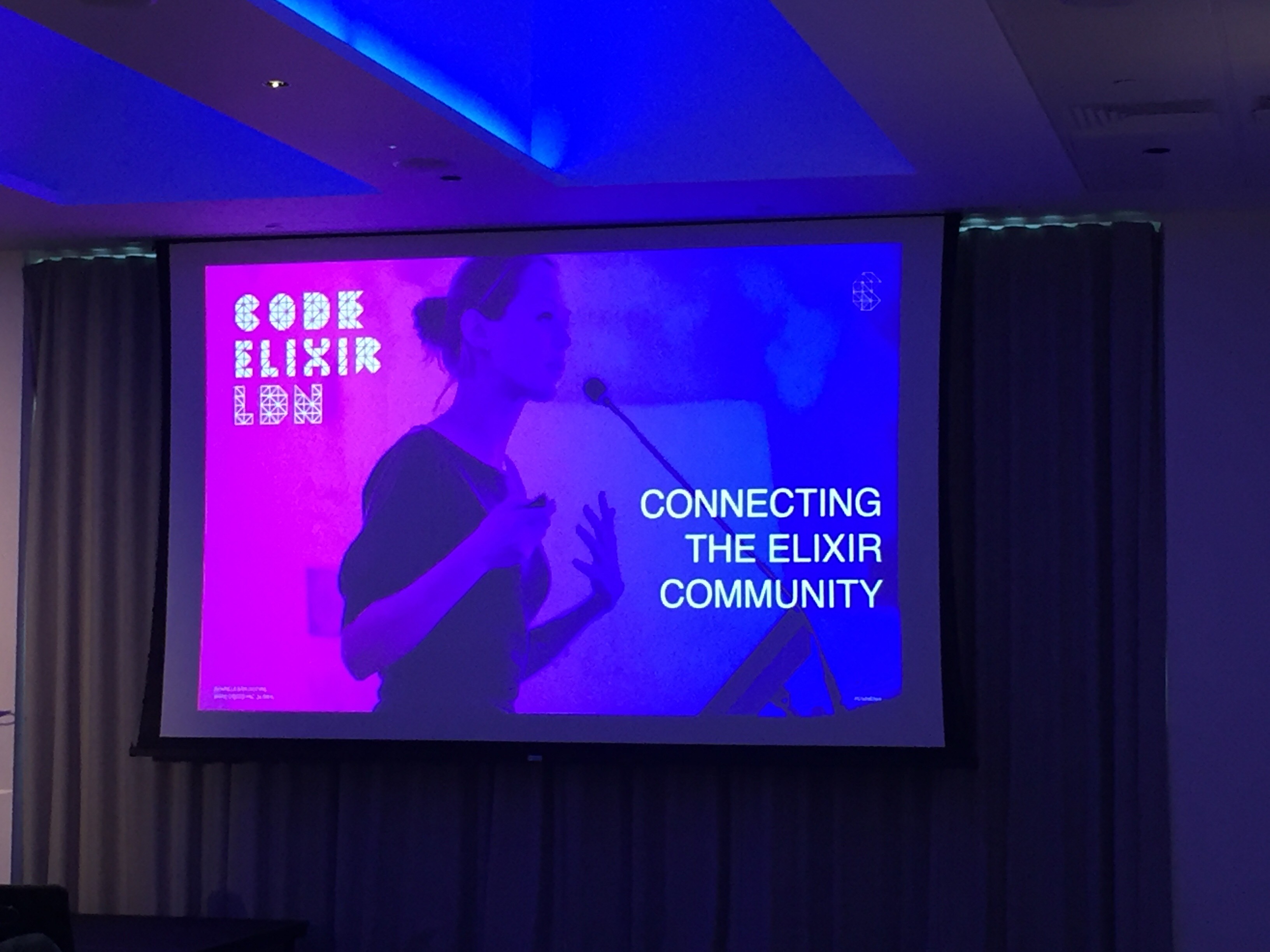
Another day, another event! This time, it was Code Mesh: Code Elixir. Code Elixir Ldn took place in London on the 17th and 18th of July 2019. Just to give a brief background: it’s a technology conference to unite the Elixir and Erlang community to share and learn from professionals within the computing/IT field. This event is held several times a year (namely London, Berlin with the odd one in the US etc.) See the ‘important information’ section for further details.

Just to clarify Code Sync comes under a family of other tech conferences as mentioned on their website: codesync.global and these are as follows:
- Code Beam: this type of conference relates to all types of languages including Elixir and Erlang that use the BEAM platform. BEAM is a virtual machine used to run programmes mentioned.
- Code Beam Lite: aims to continue the Erlang Factory Lite legacy by building a tech community to learn and share.
- Code Elixir Ldn: in London and focuses on the Elixir community to share and learn via talks, networking, show new techniques and future development.
- Code Mesh Ldn: explores alternative non-mainstream tech in the computing industry.
As with most computing conferences that I have been to so far, there’s usually a one-plus day training prior to the main conference. So in this case, a training session took place on the 16th and 17th of July called ‘Professional Liveview and OTP’ by Brian Tate and Martin Gausby. This two-day training course went through strategies of building web applications without the use of JavaScript with the focus on the server…and of course, the Elixir way!
So what is Elixir?
It is a functional-based programming language which is reliable – I mean, who likes applications crashing on their phone/mobile/computer right? Elixir has its uses in scalable backend applications with advantages of creating distributed, scalable and fault tolerant systems: i.e. it’s very productive compared to some other programming languages. Although, not as popular with programmers, it is starting to gain recognition. In fact, during the conference I spoke to a gentlemen whose (well-known) company is implementing Elixir and Erlang.

The second training session hosted by Francesco Cesarini and Gabor Olah ‘Two Tutorials: Designing and Debugging for Scalability and Reliability’ which focused on 1. design principles and tools in Elixir to get the job efficiently and correctly, and 2. focuses on Erlang feature: VM Tracing. Training is always best left for professional Erlang and Elixir developers in my opinion.
And…what is Erlang?
Well if you are using WhatsApp and Pinterest, you are enjoying the benefits of Erlang programming which is excellent for processing a load of chats and concurrent activities at the same time. Erlang was developed by the phone company ‘Ericsson’ in Sweden in the 1980’s for Telecommunications applications and services (thanks for pointing that out Herb!) to make them stable and fault-tolerant.

On the day of the conference, I was lucky enough to be crew member to a fantastic team helping out on the help desk giving out goody bags and T-shirts and then counting numbers in the talks and finally getting votes for each session. It was a great day to say the least as I got to attend all of the talks, network with both staff, professionals and potential employers and who can say ‘no’ to the After Party (unless you have a train to catch back to Wolverhampton)!
Here are some pictures of the talks:


Another noticeable factor was that there appears to be a growing demand for those who can use Elixir and Erlang #PotentialJobOpportunities. Check out some organisations such as Erlang-Solutions.


On a side note: I do plan to do a blog on Object-oriented programming VS Functional-based programming since it was a very obvious theme I noticed during the talks which, at the same time not being familiar with it but then wanting to exploring it. In my Computer Science degree, a lot of focus is on Java and C programming languages at the moment. So what do you think? Is functional programming the ‘in’ thing? Or do you prefer to stick to object-oriented (Java) programming?
Summary
Overall a fine day of networking and learning – and even better when students and lecturers from the University of Wolverhampton can attend. Remember, you don’t have to be crew member to get full benefits of the ins and outs of events, diversity tickets are also available (and it might be worth asking your university)….hope to see you in the next one:)


The important Stuff!!!
- Code Beam Lite: 20th September 2019 (Budapest)
- Code Beam Lite: 1st October 2019(New York)
- RabbitMQ Summit: 4th November 2019 (London)
- Code Beam Lite: 11th October 2019 (Berlin)
- Code Mesh Ldn: 6th – 8th November (London)
- Code Beam Lite: 29th November 2019 (Amsterdam)
- Do check out the Code Sync Website for more information.
#codeElixir #event #programming #Erlang #Elixir #CodeMesh #coding
 IT.SatOneZeroOne